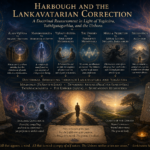
Kūkai’s celebrated Ten Stages of Mind (Jūjūshin) represents one of the most ambitious attempts in East Asian Buddhism to map the progressive transformation of human consciousness, beginning with a mind dominated by instinct and desire and ascending through increasingly refined ethical, philosophical, and Buddhist orientations until reaching the esoteric realization of Mahāvairocana characteristic of Shingon Buddhism. The architecture is impressive, encyclopedic, and at times almost overwhelming in its determination to locate the many possibilities of religious consciousness within a single ascending hierarchy. Yet when this elaborate structure is placed beside the Lankāvatāra Sūtra, Yogācāra’s analysis of consciousness, and the Mahāyāna doctrine of the ten bodhisattva bhūmis, an intriguing question arises: does awakening truly consist in climbing from one increasingly exalted state of mind to another, or must the very consciousness that constructs and experiences such stages eventually undergo a more radical transformation? The Lankāvatāra points toward parāvṛtti—the profound “turning-about” at the deepest seat of consciousness—where the discriminative machinery of vijñāna and its habitually projected world are seen through at their root. From the perspective of Unborn Mind Zen, this introduces an even sharper distinction. The Unborn cannot be situated at the summit of Kūkai’s hierarchy, nor can it be regarded as an eleventh stage beyond the tenth, for the Unborn is not a progressively acquired condition of consciousness at all. Likewise, the ten bhūmis need not be understood as ten degrees by which one gradually manufactures or approaches the Unborn; rather, they disclose the progressive maturation of the Bodhi-Child once the fundamental orientation toward awakening has occurred. Recognition is not gradual, though maturation is. Thus Kūkai’s Ten Stages, the Yogācārin transformation of consciousness, and the bodhisattva bhūmis can be read as three profoundly different maps of the spiritual journey—each illuminating something important, yet none capable of enclosing that which precedes every map. What follows, then, is not a dismissal of Kūkai’s magnificent spiritual architecture, but an attempt to look through it from the standpoint of the Lankāvatāra and the Unborn, asking what remains when the stages have fulfilled their purpose, the ladder has reached its limit, and finally even the ladder itself disappears.